
I'm reviving this blog and I've moved it to a new location.
Please visit http://nextreformation.posterous.com
Thursday, October 13, 2011


Thursday, March 5, 2009
The 9/12 Project
Fox News host Glenn Beck is doing a program called "9/12 Project" while trying to convince moderate America that their ideals aren't all wingnuttery after all.
Here are the nine principals, along with my agreement or rebuttal:
1. America is good. - NO.
It can be dangerous to label a person, nation, or group simply as “good” or “evil.” Good is as good does. Only deeds should be judged as good or evil. Former President Bush tripling funds to combat AIDS in Africa is an example of a good action. Bush lying to invade Iraq and subsequently causing the deaths of tens of thousands of innocent people is an example of an evil action. Most of the wrong done in the world has come from one nation or group of people labeling themselves as “good” and finding somebody different than them to label “evil.” It is the quickest path to discrimination, oppression, and genocide.
2. I believe in God and He is the Center of my Life. - NO.
This has absolutely nothing to do with America or government. America was founded as a free nation – a nation of liberty. You cannot be both a nation of freedom and liberty and a theocracy. Religion is a personal choice that has no place in government.
If you want to see what happens when fundamentalist religion gets mixed up with politics look to further than the Taliban. To quote founding father Thomas Jefferson, "The legitimate powers of government extend to such acts only as are injurious to others. But it does me no injury for my neighbor to say there are twenty gods or no God."
3. I must always try to be a more honest person than I was yesterday. - YES.
4. The family is sacred. My spouse and I are the ultimate authority, not the government. - YES. BUT…
The government has no place in deciding who is a family, or who can marry. At the time President Obama was born, it would have been illegal for his parents to have been wed in 16 of the states. In 1967 bigots said “Protect the sanctity of marriage: No interracial marriage.” In 2009 bigots of the same ilk say “Protect the sanctity of marriage: No gay marriage.” If you believe #4 is true, you must demand the government stop meddling in personal freedoms and grant the same civil rights to all.
5. If you break the law you pay the penalty. Justice is blind and no one is above it. - NO.
The law is not nor ever should be the decider of what is moral. Our understanding of law and morality evolve over time, and will continue to evolve. Slavery, condoned by even the Bible, was an important institution in our country from before its founding until the passing of the 13th Amendment in 1865. Who today would condemn those, like Harriet Tubman, who broke the law to assist escaped slaves before 1865? Martin Luther King spent many a night in prison for breaking laws that today we find offensive and revolting.
In fact, it was from a jail cell in Birmingham that King wrote to his critics, defending his civil disobedience and open defiance of the law, saying, “One may ask: ‘How can you advocate breaking some laws and obeying others?’ The answer lies in the fact that there are two types of laws: just and unjust. I would be the first to advocate obeying just laws. One has not only a legal but a moral responsibility to obey just laws. Conversely, one has a moral responsibility to disobey unjust laws. I would agree with St. Augustine that ‘an unjust law is no law at all.’”
6. I have a right to life, liberty and pursuit of happiness, but there is no guarantee of equal results. - YES. BUT…
We must grand these rights to all people, not simply those who live within some invisible lines arbitrarily drawn on a map. Human rights are for all people, and it is hypocritical and selfish to say only Americans have these rights. People lived in North America long before there ever was a United States, and I’m sure people will inhabit North America long after the United States is nothing but an ancient relic – the lore of history books.
The day I found inner peace was the day I stopped considering myself an American citizen, and started considering myself a neighbor, and brother, to all of humanity – and pledging to support all people to their right of life, liberty, and pursuit of happiness.
7. I work hard for what I have and I will share it with who I want to. Government cannot force me to be charitable. - NO.
Call me a socialist, if you must, but at least call me a Biblical socialist. For that is where I have drawn my guidance on charity and social justice. The truth is we must pay taxes to fund civilization. Civilization should include roads, police, prisons, and fire fighters. It should include transit, arts, basic housing, food, and clothing, hospitals, and health care. Without adequate health care, for example, many live a shortened life - or a life in pain - in direct opposition to principal #6. Health care is a human right.
Taxes should be about equal sacrifice, not equal percentage. If you don’t like funding civilization, you can join your ilk of Jim Jones or David Koresh in a remote compound somewhere. A nation is only as rich as its poorest citizens. I used to be a libertarian ("anarchy for the rich"), until I found a heart and lost the greed.
As Martin Luther King said, "A true revolution of values will soon cause us to question the fairness and justice of many of our past and present policies. On the one hand, we are called to play the Good Samaritan on life's roadside, but that will be only an initial act. One day we must come to see that the whole Jericho Road must be transformed so that men and women will not be constantly beaten and robbed as they make their journey on life's highway. True compassion is more than flinging a coin to a beggar. It comes to see that an edifice which produces beggars needs restructuring."
8. It is not un-American for me to disagree with authority or to share my personal opinion. - YES.
9. The government works for me. I do not answer to them, they answer to me. - YES.
To quote V for Vendetta, People should not be afraid of their governments. Governments should be afraid of their people.
“So, how do we show America what’s really behind the curtain? Below are nine simple principles. If you believe in at least seven of them, then we have something in common.”I decided to take an honest shot at the nine principals, scoring three Yes, two Yes with conditions, and four No. To keep Beck from wanting to water board my UN-‘Murikan ass in Gitmo, I suppose I should start praying to the flag while listening to every Toby Keith album.
Here are the nine principals, along with my agreement or rebuttal:
1. America is good. - NO.
It can be dangerous to label a person, nation, or group simply as “good” or “evil.” Good is as good does. Only deeds should be judged as good or evil. Former President Bush tripling funds to combat AIDS in Africa is an example of a good action. Bush lying to invade Iraq and subsequently causing the deaths of tens of thousands of innocent people is an example of an evil action. Most of the wrong done in the world has come from one nation or group of people labeling themselves as “good” and finding somebody different than them to label “evil.” It is the quickest path to discrimination, oppression, and genocide.
2. I believe in God and He is the Center of my Life. - NO.
This has absolutely nothing to do with America or government. America was founded as a free nation – a nation of liberty. You cannot be both a nation of freedom and liberty and a theocracy. Religion is a personal choice that has no place in government.
If you want to see what happens when fundamentalist religion gets mixed up with politics look to further than the Taliban. To quote founding father Thomas Jefferson, "The legitimate powers of government extend to such acts only as are injurious to others. But it does me no injury for my neighbor to say there are twenty gods or no God."
3. I must always try to be a more honest person than I was yesterday. - YES.
4. The family is sacred. My spouse and I are the ultimate authority, not the government. - YES. BUT…
The government has no place in deciding who is a family, or who can marry. At the time President Obama was born, it would have been illegal for his parents to have been wed in 16 of the states. In 1967 bigots said “Protect the sanctity of marriage: No interracial marriage.” In 2009 bigots of the same ilk say “Protect the sanctity of marriage: No gay marriage.” If you believe #4 is true, you must demand the government stop meddling in personal freedoms and grant the same civil rights to all.
5. If you break the law you pay the penalty. Justice is blind and no one is above it. - NO.
The law is not nor ever should be the decider of what is moral. Our understanding of law and morality evolve over time, and will continue to evolve. Slavery, condoned by even the Bible, was an important institution in our country from before its founding until the passing of the 13th Amendment in 1865. Who today would condemn those, like Harriet Tubman, who broke the law to assist escaped slaves before 1865? Martin Luther King spent many a night in prison for breaking laws that today we find offensive and revolting.
In fact, it was from a jail cell in Birmingham that King wrote to his critics, defending his civil disobedience and open defiance of the law, saying, “One may ask: ‘How can you advocate breaking some laws and obeying others?’ The answer lies in the fact that there are two types of laws: just and unjust. I would be the first to advocate obeying just laws. One has not only a legal but a moral responsibility to obey just laws. Conversely, one has a moral responsibility to disobey unjust laws. I would agree with St. Augustine that ‘an unjust law is no law at all.’”
6. I have a right to life, liberty and pursuit of happiness, but there is no guarantee of equal results. - YES. BUT…
We must grand these rights to all people, not simply those who live within some invisible lines arbitrarily drawn on a map. Human rights are for all people, and it is hypocritical and selfish to say only Americans have these rights. People lived in North America long before there ever was a United States, and I’m sure people will inhabit North America long after the United States is nothing but an ancient relic – the lore of history books.
The day I found inner peace was the day I stopped considering myself an American citizen, and started considering myself a neighbor, and brother, to all of humanity – and pledging to support all people to their right of life, liberty, and pursuit of happiness.
7. I work hard for what I have and I will share it with who I want to. Government cannot force me to be charitable. - NO.
Call me a socialist, if you must, but at least call me a Biblical socialist. For that is where I have drawn my guidance on charity and social justice. The truth is we must pay taxes to fund civilization. Civilization should include roads, police, prisons, and fire fighters. It should include transit, arts, basic housing, food, and clothing, hospitals, and health care. Without adequate health care, for example, many live a shortened life - or a life in pain - in direct opposition to principal #6. Health care is a human right.
Taxes should be about equal sacrifice, not equal percentage. If you don’t like funding civilization, you can join your ilk of Jim Jones or David Koresh in a remote compound somewhere. A nation is only as rich as its poorest citizens. I used to be a libertarian ("anarchy for the rich"), until I found a heart and lost the greed.
As Martin Luther King said, "A true revolution of values will soon cause us to question the fairness and justice of many of our past and present policies. On the one hand, we are called to play the Good Samaritan on life's roadside, but that will be only an initial act. One day we must come to see that the whole Jericho Road must be transformed so that men and women will not be constantly beaten and robbed as they make their journey on life's highway. True compassion is more than flinging a coin to a beggar. It comes to see that an edifice which produces beggars needs restructuring."
8. It is not un-American for me to disagree with authority or to share my personal opinion. - YES.
9. The government works for me. I do not answer to them, they answer to me. - YES.
To quote V for Vendetta, People should not be afraid of their governments. Governments should be afraid of their people.
Thursday, February 26, 2009
Six Steps to Save the Church - Observations by an Ex-Christian - Part 1
Part 1 - Overcome Fear with Love
Tommy Jackson, a pastor of a rural church in Texas, recently conducted an experiment – he pretended to be a drunk and homeless man wandering the church parking lot.
Reviews on various websites about the experiment were mixed. One person responded: “Of course people will act righteous. They’re in a church parking lot. They have an audience. I couldn’t even begin to recall all the holy pissing contests I’ve seen among congregations. When I was attending the Christian high school, people tried to out-holy each other all the time–as long as someone was watching. In private, especially off campus, people were considerably less Christ-like.”
Here’s one thing I’ve noticed. Most Christians - the suburban, generally wealthy or middle class ones like we have here in the South - they can deal with one or two people. They can deal with one drunk, one homeless person, one black person, one gay person.
What they can’t deal with is being a minority. They have a great fear when they are the minority in any situation - they feel unsafe, and they feel they don’t have control. I’m a minority in my neighborhood - everybody in my neighborhood is an ethic minority; there is no majority. It’s a pretty safe community but most suburban Christians would never venture here - to them it’s a “ghetto” and “unsafe” - usually code words for “there be black or brown people there.”
This is often why we never see the suburban churches helping with the urban problems. In my city there are over 5,000 homeless and only around 2,000 beds in shelters on any given night. The suburban churches see no issue in building gymnasiums that sit empty for five days a week. They can spend 30,000 on a new video projection system. They fear being out of their comfort zones. They need to be entertained. When a call goes out to collect 5,000 sets of coats and winter clothes for the homeless, local churches give a half-hearted response of around 1/5th of what is needed.
The churches can usually do an okay job at collecting some money or canned food because it doesn’t actually involve having to be around the poor and homeless. I saw photos of a church that recently hosted a “30 Hour famine” event to raise money. The youth group made card board boxes to sleep in on the front lawn of their suburban church, many painting and decorating their boxes. As somebody who has been around the homeless quite a bit over the past few years, it is hard for me to even begin describing how outrageously out of touch with reality are these people.
In fact, I find it rather insulting. It is if they are saying “I pretend to understand you and your situation even though I don’t care enough about you to even meet you, spend time with you, or get to know you.” Why not have the youth group spend the night at a homeless shelter or in a park frequented by homeless? Even better, why not have them meet every week to minister to the poor and homeless – NOT to hand out tracts to them, NOT to simply pass them a couple bucks and scurry away, but to LOVE them like Jesus loved them? Because it isn’t safe? Really? And I thought you believed you had a God watching over you and protecting you? More likely it’s because you’d be so ashamed to be seen with Lazarus, right Rich Man?
Fear has no place in the life of a Christian – except fear of a life of apathy, a life without empathy, and a life of complacency. If you fear being a minority in a group of people radically different that you, then you need to reevaluate what your beliefs. As I’ve heard before “The church needs more martyrs and less celebrities.”
Tommy Jackson, a pastor of a rural church in Texas, recently conducted an experiment – he pretended to be a drunk and homeless man wandering the church parking lot.
“Jackson wanted to test his congregation on their compassion for those in need. Playing the part to the fullest, he even had the police called on him. Some church members were [leery], but others offered food and shelter, not knowing who the mystery man was. Jackson revealed himself at the end of the Sunday service.”
Reviews on various websites about the experiment were mixed. One person responded: “Of course people will act righteous. They’re in a church parking lot. They have an audience. I couldn’t even begin to recall all the holy pissing contests I’ve seen among congregations. When I was attending the Christian high school, people tried to out-holy each other all the time–as long as someone was watching. In private, especially off campus, people were considerably less Christ-like.”
Here’s one thing I’ve noticed. Most Christians - the suburban, generally wealthy or middle class ones like we have here in the South - they can deal with one or two people. They can deal with one drunk, one homeless person, one black person, one gay person.
What they can’t deal with is being a minority. They have a great fear when they are the minority in any situation - they feel unsafe, and they feel they don’t have control. I’m a minority in my neighborhood - everybody in my neighborhood is an ethic minority; there is no majority. It’s a pretty safe community but most suburban Christians would never venture here - to them it’s a “ghetto” and “unsafe” - usually code words for “there be black or brown people there.”
This is often why we never see the suburban churches helping with the urban problems. In my city there are over 5,000 homeless and only around 2,000 beds in shelters on any given night. The suburban churches see no issue in building gymnasiums that sit empty for five days a week. They can spend 30,000 on a new video projection system. They fear being out of their comfort zones. They need to be entertained. When a call goes out to collect 5,000 sets of coats and winter clothes for the homeless, local churches give a half-hearted response of around 1/5th of what is needed.
The churches can usually do an okay job at collecting some money or canned food because it doesn’t actually involve having to be around the poor and homeless. I saw photos of a church that recently hosted a “30 Hour famine” event to raise money. The youth group made card board boxes to sleep in on the front lawn of their suburban church, many painting and decorating their boxes. As somebody who has been around the homeless quite a bit over the past few years, it is hard for me to even begin describing how outrageously out of touch with reality are these people.
In fact, I find it rather insulting. It is if they are saying “I pretend to understand you and your situation even though I don’t care enough about you to even meet you, spend time with you, or get to know you.” Why not have the youth group spend the night at a homeless shelter or in a park frequented by homeless? Even better, why not have them meet every week to minister to the poor and homeless – NOT to hand out tracts to them, NOT to simply pass them a couple bucks and scurry away, but to LOVE them like Jesus loved them? Because it isn’t safe? Really? And I thought you believed you had a God watching over you and protecting you? More likely it’s because you’d be so ashamed to be seen with Lazarus, right Rich Man?
Fear has no place in the life of a Christian – except fear of a life of apathy, a life without empathy, and a life of complacency. If you fear being a minority in a group of people radically different that you, then you need to reevaluate what your beliefs. As I’ve heard before “The church needs more martyrs and less celebrities.”
“People sometimes ask if we are scared of the inner city. We say we are more scared of the suburbs. Our Jesus warns that we can fear those things which can harm our bodies or those things which can destroy our souls, but we should be far more fearful of the latter. Those are the subtle demons of suburbia. As Shane’s mother says, “Perhaps there is no more dangerous place for a Christian to be than in safety and comfort, detached from the suffering of others.” We’re scared of apathy and complacency, of detaching ourselves of others. It’s hard to see until our 20/20 hindsight hits us, but every time we lock someone out, we lock ourselves in. Just as we are building walls to keep people out of our comfortable, insulated existence, we are trapping ourselves in a hell of isolation, loneliness, and fear. We have “gated communities” where rich folk live. We put up picket fences around our suburban homes. We place barbed wire and razor wire around our buildings and churches. We put bars on our windows in the ghettos of fear. We build up walls to keep immigrants from entering our country. We guard out borders with those walls – Berlin, Jerusalem, Jericho. And the more walls and gates and fences we have, the closer we are to hell. We, like the rich man, find ourselves locked into our gated homes and far from the tears of Lazarus outside, far from the tears of God." - Shane Claiborne and Chris Haw, Jesus for President
Tuesday, February 24, 2009
How much have you crossed off the pyramid?
I think fundamentalists Christians fear more than anything else a non-literal interpretation of the Bible and the creation story because it is often the beginning of disbelief for many ex-Christians/atheists.
This idea came from Dan Barker, but it does fit my life as well. Start with a pyramid. The pyramid has a descending order of beliefs. For example, at the top is belief in an all powerful god. Below that is the divinity of Jesus, the resurrection, the Trinity, atonement by the blood of Jesus, the belief in salvation in faith alone, etc.
At the bottom of the pyramid is maybe belief that Baptism is required to enter heaven. Or that Christians can’t work on Sundays. Most Christians don’t believe these are necessary tenants of faith, so go ahead a cross them off your list. As you go up the pyramid, you have various denominational beliefs. Some restrict pastors to being only male, for example.
As you get up the pyramid, you come to issues like belief in a literal creation story. “Well, if the creation story isn’t literal, that’s okay. It was parable, just like Adam & Eve and Cain & Able were parables. The truth is in the message of a parables.” Scratch another level off the pyramid.
Creationists/fundamentalists say “Here’s what we believe, what evidence can we find to support it?” Scientists and freethinkers say “Here’s the evidence, what conclusions can we draw from it?”
“Most of the old testament was written by a primitive people trying to understand god, so I’m not going to take everything literally. Noah was a parable. Moses was a parable. This doesn’t conflict with the belief that god loves us and has a plan for us.” Scratch another level off the pyramid.
As Christians become less literal in their interpretation of the Bible, the fundamentalists have lost control over them. They no longer have the ability to steer Christians in one direction or the other on their political agendas. No longer does it work to cherry pick one or two verses and telling Christians they must interpret this verses literally.
Eventually, as the pyramid gets smaller, you cross off things like Jesus being the only path to heaven, and eventually you doubt the need for Jesus' divinity at all. Like Thomas Jefferson and many other deists, your faith is in the overall message of Jesus, but you don’t take literally the stories of miracles or even the resurrection.
At this point you see many other stories of morality through out the world that are as good or better than the Bible. You see that morality is found outside the church. As Steve Weinberg said:
"Religion is an insult to human dignity. With or without it you would have good people doing good things and evil people doing evil things. But for good people to do evil things, that takes religion."
There’s only one block left atop the pyramid now - scratch it off.
Sunday, January 25, 2009
Hall House
There are over 2,000 children in the Charlotte-Mecklenburg School System who are homeless this winter. Several charities and government agencies came together to transform an empty building into shelter for a hundred families of schoolchildren. This was made possible by the hard work of hundreds of volunteers - young and old, religious & non-believers, who transformed the dilapidated, roach infested, abandoned building into a clean, healthy, safe, and livable home to keep children and their mothers off the streets. This is their story, which I wanted to tell through photography:
The historic Hall House, built in 1940 on Tryon Street as a luxury hotel, sat vacant and in a state of disrepair until just recently. Several charities and government organizations came together to renovate the Charlotte Housing Authority property in order to provide temporary housing for some of the city’s 2,000-plus homeless children and their mothers.
Volunteers showed up by the hundreds January 2nd and 3rd to work on the old structure and prepare it for occupancy. Six floors, each with twenty 600-square-foot units, had to be thoroughly cleaned, painted, have repairs made, and have furniture and beds delivered. Many parents who volunteered brought along their children to help. Three generations of the one family I spoke with showed up Saturday to help with preparations.
Due to fire regulations, all the old stoves had to be removed. Each kitchen will have a working refrigerator and sink, and every floor will have a microwave. A volunteer stated that the bunk beds were built by local Boy Scouts, and that all bedding such as pillowcases, sheets, and blankets have to be new and unused due to health regulations. Many sets of blankets, sporting numbers and bright logos of race car drivers, were donated by NASCAR. Much of the furniture, such as chairs and nightstands, were donated by a local hotel.
Twenty children and their mothers began moving in later thatweek, with 20 more each following week until the Hall House is home to 100 families. The Hall House is planned to be only a temporary shelter, and volunteers hope to find many of the residents permanent housing by July.
To be continued...
Wednesday, December 31, 2008
A search for the true meaning of Christmas
It seems almost cliche now for somebody to discover the true meaning of Christmas. After all, we see George Bailey and Ebenezer Scrooge and even the Grinch all find the true meaning of Christmas every year on our televisions while we unwrap our toys and feast in excess.
Early in December I came to understand and accept that I am an atheist. I wondered how this Christmas be different – a Christmas without Jesus. I wanted to tell everybody how Jesus’ birth was just an amalgamation of various solar deities, many of whom predate the New Testament and share a birthday with Jesus. I wanted to tell everybody how Jesus is really just a Santa for adults; how wreaths, Yule logs, and even Christmas trees are from pagan traditions, and are actually condemned by the Bible. I wanted to send out “Axle tilt is the reason for the season” greeting cards. No matter how much I wanted Jesus, or Santa, to be real it would not change the reality that they are both just myths.
The “War on Christmas” flared up again this year, with TV commentators blasting those who want to place displays to other (or no) religions and holidays alongside Christian displays. Pastors railed against those who wish others “Happy Holidays” rather than “Merry Christmas.” It all became rather silly as I found myself standing in a Bed, Bath, & Beyond, watching the shoppers endlessly circling the parking lot, rushing in and filling their carts with useless trinkets and devices. Many people would soon exchange gift cards to the same big box stores with each other. “Hmmm” I thought, glancing over at a display. “This lemon zester cost over three days wages in much of the world, and this onion slicer cost almost a month’s salary.” How did we get to this point from celebrating a birthday that was heralded as bringing “peace, goodwill to men” – a person whose life taught us to serve the poor and needy, and love the outcast and alien?
The more I thought about the holiday season, the more I thought about the people in my community. I found out about a local ministry, Clothe Charlotte, was undertaking an ambitious project – collect and distribute sets of winter hats, gloves, and coats for every homeless person in the city. Assisting the homeless and needy in my city is something important to me. I worked to promote Clothe Charlotte and participated in the collection, sorting, and distribution of sets of winter clothes for the homeless. Clothe Charlotte was sponsored by Kinetic Church. It was refreshing to see a church so dedicated to a service project – one that focuses on the “honey” of doing “unto the least of these” rather than focusing on the “vinegar” of handing out tracts and evangelizing, especially when the news features stories of churches kicking out homeless ministries because they didn’t pray and sit through a sermon before eating.
We sorted and packed sets of winter clothes at Freedom Park, and despite the light drizzle spirits were high. I delivered a car load of clothes to CUP Ministry – one of many shelters and ministries throughout the city to receive clothes. As car after car pulled in loaded with winter clothes, the minister clapped his hands loudly as his stood on the back porch of the house-turned-food pantry.
Helping Clothe Charlotte was one of my best holiday memories in years. The holiday season is all about light in the darkness, love in the cold, and taking time from our busy lives to do good in the world. Don’t allow the sectarian and political bickering take focus away from the universal ideals of peace, love, family, and community. Whether we’re Christian, Jewish, or atheist – whether we celebrate Christmas, Winter Solstice, or Festivus – we can all join in the goodwill spirit of season and join together in helping our neighbors.
An introduction to Clothe Charlotte:
Clothe Charlotte '08 from Kinetic Church on Vimeo.
My Flickr slideshow of Clothe Charlotte:
A video of Clothe Charlotte that features several of my photos:
ClotheCLT from ClotheCharlotte on Vimeo.
Early in December I came to understand and accept that I am an atheist. I wondered how this Christmas be different – a Christmas without Jesus. I wanted to tell everybody how Jesus’ birth was just an amalgamation of various solar deities, many of whom predate the New Testament and share a birthday with Jesus. I wanted to tell everybody how Jesus is really just a Santa for adults; how wreaths, Yule logs, and even Christmas trees are from pagan traditions, and are actually condemned by the Bible. I wanted to send out “Axle tilt is the reason for the season” greeting cards. No matter how much I wanted Jesus, or Santa, to be real it would not change the reality that they are both just myths.
The “War on Christmas” flared up again this year, with TV commentators blasting those who want to place displays to other (or no) religions and holidays alongside Christian displays. Pastors railed against those who wish others “Happy Holidays” rather than “Merry Christmas.” It all became rather silly as I found myself standing in a Bed, Bath, & Beyond, watching the shoppers endlessly circling the parking lot, rushing in and filling their carts with useless trinkets and devices. Many people would soon exchange gift cards to the same big box stores with each other. “Hmmm” I thought, glancing over at a display. “This lemon zester cost over three days wages in much of the world, and this onion slicer cost almost a month’s salary.” How did we get to this point from celebrating a birthday that was heralded as bringing “peace, goodwill to men” – a person whose life taught us to serve the poor and needy, and love the outcast and alien?
The more I thought about the holiday season, the more I thought about the people in my community. I found out about a local ministry, Clothe Charlotte, was undertaking an ambitious project – collect and distribute sets of winter hats, gloves, and coats for every homeless person in the city. Assisting the homeless and needy in my city is something important to me. I worked to promote Clothe Charlotte and participated in the collection, sorting, and distribution of sets of winter clothes for the homeless. Clothe Charlotte was sponsored by Kinetic Church. It was refreshing to see a church so dedicated to a service project – one that focuses on the “honey” of doing “unto the least of these” rather than focusing on the “vinegar” of handing out tracts and evangelizing, especially when the news features stories of churches kicking out homeless ministries because they didn’t pray and sit through a sermon before eating.
We sorted and packed sets of winter clothes at Freedom Park, and despite the light drizzle spirits were high. I delivered a car load of clothes to CUP Ministry – one of many shelters and ministries throughout the city to receive clothes. As car after car pulled in loaded with winter clothes, the minister clapped his hands loudly as his stood on the back porch of the house-turned-food pantry.
Helping Clothe Charlotte was one of my best holiday memories in years. The holiday season is all about light in the darkness, love in the cold, and taking time from our busy lives to do good in the world. Don’t allow the sectarian and political bickering take focus away from the universal ideals of peace, love, family, and community. Whether we’re Christian, Jewish, or atheist – whether we celebrate Christmas, Winter Solstice, or Festivus – we can all join in the goodwill spirit of season and join together in helping our neighbors.
An introduction to Clothe Charlotte:
Clothe Charlotte '08 from Kinetic Church on Vimeo.
My Flickr slideshow of Clothe Charlotte:
A video of Clothe Charlotte that features several of my photos:
ClotheCLT from ClotheCharlotte on Vimeo.
Monday, December 8, 2008
Small Towns Versus Big Cities - Searching for "Real America"
I sat on a chilly metal bench at the airport overlook – a small park next to Charlotte-Douglas International that offers a great view of one of the runways. In the distance stands the skyline with tiny little cranes moving back and forth over a new skyscraper going up. With head tilted to one side and arm outstretched, I see if it has yet grown larger than my thumb. As the planes come in, I stretch out my arm and try to pinch them between my index finger and thumb, increasing in size until they are too large to fit in my open palm. This one is the daily flight from Munich, Germany. I often come here to do my thinking. I’ve lived in the heart of the city for several years now, after spending almost my entire life in a rural town an hour or so away. It is just days before the election and the biggest thing on my mind is the rift between perceived “small town values” and “big city values.”
The Republican National Convention had speaker after speaker who espoused the greatness of small town values in "real America." The Daily Show had aired a segment asking “What are these small town values?” Now North Carolina had become the latest battle ground over what is “real America.” Sarah Palin, speaking at a rally outside Greensboro, North Carolina, said “We believe that the best of America is in these small towns that we get to visit, and in these wonderful little pockets of what I call the real America, being here with all of you hard working very patriotic, very pro-America areas of this great nation.” Palin nor McCain ever dared to set foot in Charlotte, instead holding a rally outside the city alone a rural stretch of Highway 49. It was here that, before McCain spoke, House Representative Robin Hayes said “Liberals hate real Americans that work and accomplish and achieve and believe in God,” a comment he denied making until an audio recording proved otherwise.
I thought back to the summer days of my youth. My father would lift me into the air with his large hands, worn and calloused from many years spent in the local steel mill. His right ring finger half as long as the others, a permanent reminder of his Marine Corp tours in Vietnam. We would spend many summer afternoons in our back yard K-mart kiddy pool. My father was transferred from the steel plant in his boyhood hometown in Alabama when I was still too young to remember. He worked hard to make an honest living for my mother, my sister, and me. My mother worked part time in the local school system driving a bus and serving in the cafeteria. They were always active in my school and church, coaching my T-ball team or leading the children’s ministry with puppets. These were what I leaned were small town values; hard work, honesty, honoring your family, love of God, and love of country.
It is very hard to spot – only after years away from small towns, and from the outside looking in, that I can see the cracks in the so-called “small town values.” There is a great deal of politeness on the surface in rural areas, but it is only skin deep. You're okay as long as you look like everyone else, they think you are a good Christian, and aren't gay or something. Once you get past superficial politeness you'll be shocked at the fear and hate boiling under the surface. Some of it erupted during the election with angry mobs of Republican supporters.
Fear is what drives life in small towns. Fear of change. Fear of a shifting power structure. Fear of something or somebody different. It stems from an “us versus them” mentality and an oversimplification of everything as being either “good” or “evil.” There is no room for gray. Christians, especially, are taught that the world is out to get them – to destroy their country, their community, and their values. Power hungry politicians and pastors (with an increasingly blurred like between the two) demonize those who are different as a method to keep their followers in check. “The gays want to destroy our families, the Mexicans are stealing our jobs, and the blacks steal all the welfare money.” There is no room at the table for opposing views or independent thought. In their minds, good Christian folk are being persecuted. Cable news commentators, and my former pastor, told me the 1950’s were the greatest time in our nation’s history. When I hear that today I’m shocked. After all, in the 1950’s segregation was in full force, Jim Crow laws were in effect, and the glass ceiling was as high and firm as ever.
Along with fear, stereotypes drive small town perceptions of “outsiders.” In small towns, residents tend to lump people into large groups. You have your whites and blacks, all Latinos are labeled as Mexicans, and Asians are Chinese, and then there are those of “terrorist descent.” When you don’t know somebody outside of stereotypes, it is nearly impossible to care about them, and very easy to become wary of them. The small town is the comfort zone for those who fear the poor or foreign. Shane Claiborne said in The Irresistible Revolution, “I asked participants who claimed to be "strong followers of Jesus" whether Jesus spent time with the poor. Nearly 80 percent said yes. Later in the survey, I sneaked in another question, I asked this same group of strong followers whether they spent time with the poor, and less than 2 percent said they did. I learned a powerful lesson: We can admire and worship Jesus without doing what he did. We can applaud what he preached and stood for without caring about the same things. We can adore his cross without taking up ours. I had come to see that the great tragedy of the church is not that rich Christians do not care about the poor but that rich Christians do not know the poor.”
Small town America is stubborn and slow to accept progress and grant equality and liberty to all. Living in mostly segregated, rural areas breeds bigotry, racism, xenophobia, a general disregard for the poor and needy, and disdain for people and beliefs other than your own. Small-town-mindedness encourages anti-intellectualism, jingoism, and blind devotion to religion and government (which have an increasingly blurred line between the two). In addition, small town bigotry shifts over time. While segregation was a sacred institution in rural towns for most of this country’s history, many rural residents now take pride in how they “aren’t racist” and even have a token black friend to prove it. In 1968 the battle cry was “Protect the sanctity of marriage; no interracial marriage.” In 2008 it had evolved into “Protect the sanctity of marriage; no gay marriage.” I often hear stories of people from small towns who leave for college. At first they have a prejudice against gays or Muslims or some other group. Maybe their pastor preached on the evils of homosexuality. They believe it, until they actually befriend a gay person. Then they learn to judge their new friend by their character, and not the stereotype hung around their neck by a small minded pastor.
I’ve come to love the city so much that I could never imagine going back to a rural town. There is a great community in the city, an exchange of ideas where everybody has a place at the table. I’ve learned that people that are different than me aren’t the enemy. We’re all different, and that’s what makes us great. Once you get to know people, the stereotypes learned in the small towns are washed away. Eventually, we can stop labeling people all together, and accept them as individuals. It took some time - several years - after initially moving into the city before I realized I had become a liberal. I had come to cherish several important big city values; tolerance, peace, equality, justice, and a desire to treat others as I would want to be treated. I didn’t care about gays until I made gay friends. I didn’t care about the poor until I knew them and, in a way, joined them.
The morning after the election I drove though the small town of my youth. I’d often seen a Confederate flag flying on a pole along the highway just outside of town, but that day it was lowered to half mast. I mentioned it to a friend in Raleigh. “The Confederate flags are flying at half mast in the South today, haha,” he later responded. “Thanks for that joke; I’ve been telling it all morning!” Except, it wasn’t a joke.
The Republican National Convention had speaker after speaker who espoused the greatness of small town values in "real America." The Daily Show had aired a segment asking “What are these small town values?” Now North Carolina had become the latest battle ground over what is “real America.” Sarah Palin, speaking at a rally outside Greensboro, North Carolina, said “We believe that the best of America is in these small towns that we get to visit, and in these wonderful little pockets of what I call the real America, being here with all of you hard working very patriotic, very pro-America areas of this great nation.” Palin nor McCain ever dared to set foot in Charlotte, instead holding a rally outside the city alone a rural stretch of Highway 49. It was here that, before McCain spoke, House Representative Robin Hayes said “Liberals hate real Americans that work and accomplish and achieve and believe in God,” a comment he denied making until an audio recording proved otherwise.
I thought back to the summer days of my youth. My father would lift me into the air with his large hands, worn and calloused from many years spent in the local steel mill. His right ring finger half as long as the others, a permanent reminder of his Marine Corp tours in Vietnam. We would spend many summer afternoons in our back yard K-mart kiddy pool. My father was transferred from the steel plant in his boyhood hometown in Alabama when I was still too young to remember. He worked hard to make an honest living for my mother, my sister, and me. My mother worked part time in the local school system driving a bus and serving in the cafeteria. They were always active in my school and church, coaching my T-ball team or leading the children’s ministry with puppets. These were what I leaned were small town values; hard work, honesty, honoring your family, love of God, and love of country.
It is very hard to spot – only after years away from small towns, and from the outside looking in, that I can see the cracks in the so-called “small town values.” There is a great deal of politeness on the surface in rural areas, but it is only skin deep. You're okay as long as you look like everyone else, they think you are a good Christian, and aren't gay or something. Once you get past superficial politeness you'll be shocked at the fear and hate boiling under the surface. Some of it erupted during the election with angry mobs of Republican supporters.
Fear is what drives life in small towns. Fear of change. Fear of a shifting power structure. Fear of something or somebody different. It stems from an “us versus them” mentality and an oversimplification of everything as being either “good” or “evil.” There is no room for gray. Christians, especially, are taught that the world is out to get them – to destroy their country, their community, and their values. Power hungry politicians and pastors (with an increasingly blurred like between the two) demonize those who are different as a method to keep their followers in check. “The gays want to destroy our families, the Mexicans are stealing our jobs, and the blacks steal all the welfare money.” There is no room at the table for opposing views or independent thought. In their minds, good Christian folk are being persecuted. Cable news commentators, and my former pastor, told me the 1950’s were the greatest time in our nation’s history. When I hear that today I’m shocked. After all, in the 1950’s segregation was in full force, Jim Crow laws were in effect, and the glass ceiling was as high and firm as ever.
Along with fear, stereotypes drive small town perceptions of “outsiders.” In small towns, residents tend to lump people into large groups. You have your whites and blacks, all Latinos are labeled as Mexicans, and Asians are Chinese, and then there are those of “terrorist descent.” When you don’t know somebody outside of stereotypes, it is nearly impossible to care about them, and very easy to become wary of them. The small town is the comfort zone for those who fear the poor or foreign. Shane Claiborne said in The Irresistible Revolution, “I asked participants who claimed to be "strong followers of Jesus" whether Jesus spent time with the poor. Nearly 80 percent said yes. Later in the survey, I sneaked in another question, I asked this same group of strong followers whether they spent time with the poor, and less than 2 percent said they did. I learned a powerful lesson: We can admire and worship Jesus without doing what he did. We can applaud what he preached and stood for without caring about the same things. We can adore his cross without taking up ours. I had come to see that the great tragedy of the church is not that rich Christians do not care about the poor but that rich Christians do not know the poor.”
Small town America is stubborn and slow to accept progress and grant equality and liberty to all. Living in mostly segregated, rural areas breeds bigotry, racism, xenophobia, a general disregard for the poor and needy, and disdain for people and beliefs other than your own. Small-town-mindedness encourages anti-intellectualism, jingoism, and blind devotion to religion and government (which have an increasingly blurred line between the two). In addition, small town bigotry shifts over time. While segregation was a sacred institution in rural towns for most of this country’s history, many rural residents now take pride in how they “aren’t racist” and even have a token black friend to prove it. In 1968 the battle cry was “Protect the sanctity of marriage; no interracial marriage.” In 2008 it had evolved into “Protect the sanctity of marriage; no gay marriage.” I often hear stories of people from small towns who leave for college. At first they have a prejudice against gays or Muslims or some other group. Maybe their pastor preached on the evils of homosexuality. They believe it, until they actually befriend a gay person. Then they learn to judge their new friend by their character, and not the stereotype hung around their neck by a small minded pastor.
I’ve come to love the city so much that I could never imagine going back to a rural town. There is a great community in the city, an exchange of ideas where everybody has a place at the table. I’ve learned that people that are different than me aren’t the enemy. We’re all different, and that’s what makes us great. Once you get to know people, the stereotypes learned in the small towns are washed away. Eventually, we can stop labeling people all together, and accept them as individuals. It took some time - several years - after initially moving into the city before I realized I had become a liberal. I had come to cherish several important big city values; tolerance, peace, equality, justice, and a desire to treat others as I would want to be treated. I didn’t care about gays until I made gay friends. I didn’t care about the poor until I knew them and, in a way, joined them.
The morning after the election I drove though the small town of my youth. I’d often seen a Confederate flag flying on a pole along the highway just outside of town, but that day it was lowered to half mast. I mentioned it to a friend in Raleigh. “The Confederate flags are flying at half mast in the South today, haha,” he later responded. “Thanks for that joke; I’ve been telling it all morning!” Except, it wasn’t a joke.
Tuesday, December 2, 2008
I'm Coming Out
I’m not sure which my parents would be more upset about – that I voted for Barack Obama or that I am now an atheist. The struggle to come to terms with my beliefs was a long, difficult process that took me through the depths of depression and back. I didn’t want to be an atheist. I wanted God to be real. I want church. I miss church. But I have to truthful to myself and to those around me. I can’t live a lie. I have come to terms, though critical thinking and intellectual honesty, what I know is true: There is no God.
Growing up, I was very active in a Southern Baptist church from grade school though college. I became well versed in Southern Baptist theology and served in music, Vacation Bible School, domestic and international mission trips, and youth leadership in my church. I truly believed in God with all my heart, with all my mind, and with all my soul.
I always thought that Christians became atheists because they were mad a God. Surely it is an act of rebellion against giving God total control of their life. The complete opposite happened to me.
I drifted away from the faith for several years, but then I discovered several progressive Christian writers such as Shane Claiborne and Donald Miller, and I felt a renewed zeal to study the Bible and pursue my personal relationship with God. It's funny that this pursuit of God led to my atheism.
Several years ago I traveled to Japan and China and visited Shinto shrines and Buddhist temples and it occurred to me that these people that I was meeting and getting to know have morals and ethics often as great as or greater than most Christians I know. I read Confucius Lives Next Door by T.R. Reid and pondered how can so many Asians have such high moral standards, lower crime rates, stronger communities and families, all without Jesus? Around this same time, over the span of several years, I began to learn more about the world around me. When I was little, God was bigger than I could imagine and there was no truth, no morality outside God. One day I came across this thought exercise: “If God told you to kill someone, would you do it?” Of course the answer would be that God would never ask me to do that. “But if he did tell you, that it was for the greater good, part of his plan?” I would have to answer no. My morals would never allow me to take another life. I’m a firm believer in non-violence and pacifism. At this moment, I was almost shocked to realize what this means: my values go beyond God – go deeper than God. It is as if God got a little smaller, or the universe as I know it got a little larger.
As I studied the Bible more, the more issues with theology I discovered. Perhaps the greatest issue I had was with salvation, or simply “who goes to heaven and who goes to hell.” If salvation is though faith in Jesus alone, then it is unjust to condemn those who have never heard the Gospel, and equally unfair if these people get a “free pass” while those who, to varying degrees, have heard the Gospel are judged. The more and more I learned about the world, the more I disagreed with the exclusivity of faith in Christ. Somebody who earnestly says a prayer accepting Jesus, then goes about life as usual, is more deserving of heaven than a Buddhist monk who dedicates his entire life to feeding the poor and clothing the needy, and caring for the sick? After all, Matthew 25 pretty plainly states that those who do “unto the least of these” are rewarded with heaven and those who selfishly do not are condemned. How do you reconcile “faith alone” with this teaching? How does simply saying a prayer supersede this? Maybe just praying the “Sinner’s prayer” and repenting of sins is not enough.
Jesus teaches that “it is easier for a camel to pass through the eye of a needle than for a rich person to enter the Kingdom of God.” America is the richest nation on earth, run by greed and a desire to horde wealth. The average American household makes over $50,000.00 a year while much of the world lives on two dollars a day. In fact, Americans spend more on trash bags in a year than most people in third world countries spend on all their purchases. Churches are no different, building hundred-thousand dollar basketball gyms and installing thirty-thousand dollar multi-media systems. A hundred and thirty five million people are expected to die by 2020 due to lack of clean drinking water. Basic sanitation could be provided for most of these people for around ten billion dollars. It sounds like a lot until you consider that Americans will spend nearly 450 billion on Christmas presents this year alone. If what Jesus said about the rich was true, then virtually no American, or even any church in America, deserves to enter the Kingdom of God. In a just world, America deserves to be punished.
I thought that perhaps I am a Universalist – that there are many paths in life and all people will be reconciled to God eventually. But if this is true, then why is there a need to believe in God anyway? What’s the difference, as long as I seek to live out the message of Matthew 25 and seek to “love my neighbor as myself?”
Still, I tried fervently to seek God in spite of growing doubts. I wanted to believe that he existed. I prayed that he would show me the way. I prayed until I cried, begging that he would restore my faith. I read more Christian books and studied the Bible. Eventually I accepted what my heart and mind was telling me – there is not God. It’s not that I didn’t believe in Jesus’ teaching, but that his divinity and the existence of a God seemed increasingly unlikely in light of what I was learning about the world around me. I never stopped believing in the Bible in the sense that it is the greatest source of moral truth in my life. Jesus’ teachings such as the Sermon on the Mount and Matthew 25 form the basis of my ethics. I will always follow my conscience and seek peace, justice, equality for all people through love.
I guess some Christians will say it is okay – people take many paths and all people will be reconciled to God eventually. Some will say that I’ll eventually “come back around.” Some will say that I was never a Christian to begin with. My faith was completely real to me. I was certain that God heard and answered my prayers. I felt his supernatural presence in still quiet moments of worship. But now I realize that it was just a creation of my own mind. I want to be honest with myself and use reason and logic, not blind faith, to explore the world. Life as a human being is very precious, and it is something to be cherished. I want to spend my life creating “heaven” on earth for the “least of these.” I hope Christians will truly follow the teachings of Jesus work with me to do just that.Wednesday, November 5, 2008
Why Christians voted for a pro-choice President
Why did I vote for a pro-choice President?
First, I really focused on what Jesus taught. The Sermon on the Mount. Matthew 25. Do you know how many verses in the Bible directly address abortion? Zero. How many directly address poverty and oppression? Over 2,000. The scandal Poverty is a life issue that is very important to me.
Second, author Jim Wallis did a good job of explaining “pro-life” when he wrote,
“Choosing life” is a constant Biblical theme, so I will choose candidates who have the most consistent ethic of life, addressing all the threats to human life and dignity that we face — not just one. Thirty-thousand children dying globally each day of preventable hunger and disease is a life issue. The genocide in Darfur is a life issue. Health care is a life issue. War is a life issue. The death penalty is a life issue. And on abortion, I will choose candidates who have the best chance to pursue the practical and proven policies which could dramatically reduce the number of abortions in America and therefore save precious unborn lives, rather than those who simply repeat the polarized legal debates and “pro-choice” and “pro-life” mantras from either side.”
Third, the idea that simply overturning Roe v. Wade will end abortion is as outdated as it is uncaring. It is time to try a new approach; addressing the social and economic reasons behind why most women feel the need for an abortion, and doing it out of a feeling of love and genuine kindness towards the women forced to make such difficult decisions. The old way has failed, let’s be willing to open our hearts to a new way of addressing the issue. The website Pro-Life Pro-Obama has some good research on the issue from a Christian perspective.
We Christians need to take a step back for a moment and look at the big picture. We need more dialogue and less shouting from both sides. Consider this thought from Omar Al-Rikabi at God’s Politics:
“On one side, so-called “values voters” rally for the right to life of the baby. But they see my cousin’s death and the displacement of his family (in Iraq) as “collateral damage” in a war for freedom and their own security.
On the other side, so-called “change voters” protest a war that claims the life of innocents. But they see my unborn daughter’s life or death as a “freedom of choice.”
When I look at the reality of my family in light of a consistent ethic of life, all I hear from most politicians and preachers are inconsistencies. Both sides argue freedom for a way of life. But is any of this really about freedom, or just misplaced selfishness? Could it be as Bono once sang that, “what you thought was freedom was just greed.”
Monday, November 3, 2008
Jesus for President
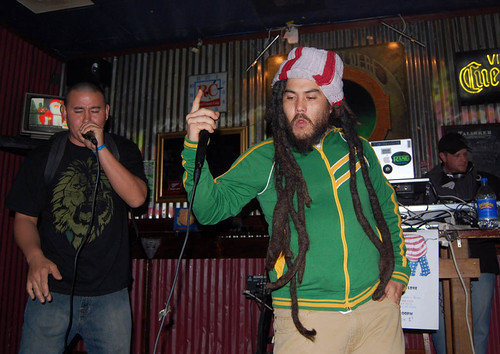
The air is filled with smoke in the back room of the Philosopher's Stone Tavern Saturday night in downtown Charlotte. Three days from the 2008 Presidential Election and North Carolina has become a battle ground state with McCain and Obama in a statistical dead heat here. Yet as local hip-hop and rock group One Big Love perform, there were several mentions of candidates who will not be on the ballot November 4th, including an impromptu song about the election:
"I don't want to vote for McCain. I don't want to vote for Obama. I want to write in Jesus."
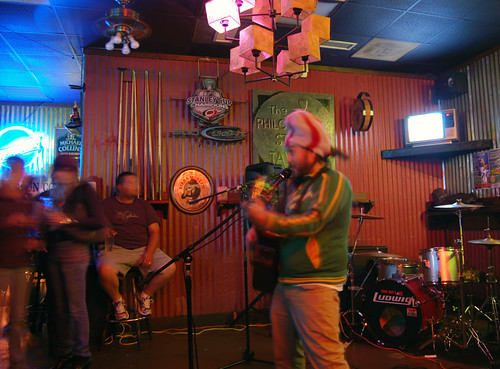
"We all grew up in the country," Josh says. Brothers Josh and Jason form the core of One Big Love, and aren't afraid to share their views on rap, politics, and growing up in rural North Carolina. "What we'd like to accomplish with out music is to get people to open up their mind. It's got to happen with a revolution of information," says Jason before the show. "Do you think all them rich folk out there care about what's going on here?" Throughout the show the guys express their doubts in the two-party system changing the status quo any time soon, summed up by the original artwork on their fliers, which features a donkey and elephant joined together and painted with an upside-down American flag.
Listening to their music you get a message different than most hip-hop on the radio today, more in the vein of Public Enemy's Fight the Power. Lyrically and occasionally musically the group is similar to Colorado intelli-rap group The Flobots, who speak of social justice with Christian overtimes. Josh says, "We're anti-bling, we don't rhyme about any of that. It's so country and so real. We don't say one thing about Cadillacs. We didn't grow up like that. And people out there rhyme about it that don't have that, like Jason says 'congratulations on being wack.'"
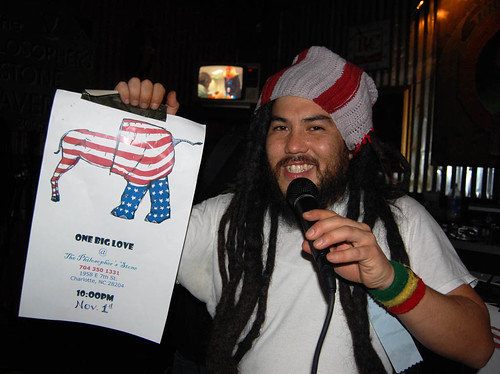 A around a year ago I initially started my spiritual journey to rediscover who Jesus really is, looking at the Bible and forgetting the religious dogma and political spin. I started thinking and having ideas, not knowing at the time that I wasn't alone with these thoughts, or that anybody else had come to any similar conclusions. The brothers haven't heard of Shane Claiborne' s book Jesus for President, but they see past what the religious and political parties are telling us to believe. "Write in Jesus!" They proclaimed again later, as Josh holds up one of the posters for the cheering crowd. It is a sort of epiphany where I think, "Maybe there really is a revolution going on here in Jesusland."
"I try to come from a Biblical standpoint, plain and simple, and that's what the world needs right now," Jason says. "This is Babylon, for real, there's so much confusion and I try to be a beacon for truth. Not everyone knows what's going on, and I'm not saying I do. I try to make people think outside what they hear on the radio or on CNN. It's really a positive movement going on."
Friday, October 24, 2008
The Good Spirit
I've been thinking a lot lately about "small town values." Various politicians in this election have espoused the virtue of "small town values" and how small towns are the "real America." I grew up in a very small town before I moved into the city, so I've seen both worlds, and this week I've been writing about my observations which I'll post soon. In the meantime, I wanted to share a blog posting that really touched my heart. This is the story of fellow blogger and Charlotte bicycle courier Bill and his encounter with The Good Spirit, "local Charlotte artist who had lived on the streets." This story speaks of our values here in the Queen City; of friendship, respect, and seeking justice.
This Sunday is the 2 year anniversary of the Death of my friend The Good Spirit, David Ray Chisholm. I realize that anniversary dates are sometimes over emphasized to the point of the understanding and true meaning being lost however in this case I can never unlearn the impact this man had on my life. All that took place by knowing Ray and being part of his untimely death has influenced my understanding of not only true justice but of our place in society and I cannot look away from the obvious. The Good Spirit gave me an education that could not be paid for and his life legacy has been part of my inspiration to make photographs, write and share with those who take a peek into the blogosphere. I ask that you take a minute and read my very first post in memory of David Ray Chisholm better known as The Good Spirit......

Monday, October 13, 2008
Entitled to Bitterness?
I was called out recently. I posted on an internet forum and referenced “right wing blowhards” in a confrontational rant about my beliefs about how Christians should act. A response I received was a bit of a wakeup call.
“Guys, please don’t call people names just because they disagree with your stance. There’s nothing Christian about calling conservatives ‘crazy’ or ‘blowhards’. Someone said that in their experience, leftists tend to be more mean-spirited than those on the right. An honest perusal of the posts so far bears this out.”
This got me started thinking about how I feel about the church and how I feel about religious leaders with viewpoints different than my own. I realized I was angry. I was angry and bitter. And worse, I felt entitled to my bitterness. After years of religious indoctrination and institutionalization, I felt deep betrayal and hurt after I finally broke away and formed my own ideas and beliefs about Jesus and His teaching. I was angry because I felt I was always attacked from every side. Not only am I attacked by the secular left for believing in God, but I am attacked by the religious right for dining with the enemy. I’m told no true Christian would vote for this person or hang out with that person or do any number of things on a never ending laundry list.
I’ve been reading several books on religion and Christianity as part of my quest to find my place in today’s church. One of the books is Chris Hedges’ collection of articles based on the Ten Commandments, entitled “Losing Moses on the Freeway.” In his section on the Sabbath, he begins with a story of his time spend in a boarding school, and speaks of tyrannical teachers and regimented life. He writes of the schools formal adherence to religious ritual and doctrine:
“Religion, like learning, was part of the effort to bend us into dutiful and compliant young men. It was meant to curb and thoughts of rebellion, of self expression, of liberation.”
While I had never attended a boarding school, having been at church at least three times a week for twenty-odd years, I understood the feeling of being institutionalized and controlled. While most of the time I didn’t detest it, church was never simply an option for me. While I lived under my father’s roof, I would obey his rules, or so he said.
Chris goes on to talk about one act of rebellion by the boys at the boarding school. The headmaster and teachers instructed all the boys to walk up a hill, collecting rocks so the mowers would not hit them. In a spontaneous act of defiance, the boys began throwing the rocks up at the hastily retreating teachers.
“The prophets spent their days raging against corruption and abuse of power by those in the royal palaces and courts, the mistreatment of the poor, of widows and orphans, in short the hard and difficult struggle of the oppressed to achieve freedom and dignity. They were angry, indignant over the minor infractions. The prophets, I understood years later, would have been standing on the bottom of the hill with us, not at the top with the school officials who ruled us. But the message of the prophets, like all messages passed on to us, was twisted to pressure us to conform.”
I, too, had been throwing rocks of my own, verbal rocks, at religious leaders. After all, am I not entitled to my bitterness? I was like a person in an abusive relationship; I knew it was hurting me but I kept going back. I was dependant on my church. I felt I needed approval from my church. But every time I went back I would hear something that conflicted with my beliefs, and again anger would swell up inside of me. After I severed all ties, I still longed for my old flame, and the approval that I lacked.
During this time I was also reading “Blue Like Jazz” by Donald Miller. I was very moved by his path to Christian spirituality, how he found his place in the church, and I felt as though he was talking to me and understood my situation. I came to a chapter titled “Church. How I go without getting angry.” “Ooh, that is me.” I thought, as read the words with great interest. Don lays out several issues that he has with the church, and says:
“I told [the pastor] it was hard for me to go to church without getting angry, and I think he took that personally. I tried to explain how I felt, but I was speaking a different language. I felt stupid, too, like some bitter idiot all wet and wanting everybody to cater to me, to my ideas about who Jesus is and was and the way He wants us to live.”
Don talks about finding a church where he fits in, and goes on to talk about how he had to let go of any bad attitude.
“I had to tell my heart to love the people from the churches I used to go to, the people who were different than me. This was entirely freeing because when I told my heart to do this, my heart did it, and now I think very fondly of those wacko Republican fundamentalists, and I know that they love me, too, and I know that we will eat together, we will break bread together in heaven, and we will love each other so purely it will hurt because we are a family in Christ.
Don’t hold grudges against any other churches. God love those churches almost as much as He loves yours.”
As I read this, I finally understood how to relate to my former church. I knew my bitterness was only hurting me, hurting my relationship with God, and hurting any efforts to find common ground and understanding with those of different views. What I needed was to love my previous church, and the religious leaders I disagree with, because without love and forgiveness there is no way I could ever have civil discussion or interaction with them again. I prayed for God to take away my bitterness and anger, and now I feel a great deal more peace. Now I can face people of my past with love and understanding. In fact, over the next few weeks I plan on hanging out with several old friends and acquaintances of my former church and hope to have good conversation about faith and sense of place in the church. Bridges are not burnt and I pray they never will be.
On the internet forum, I wrote a reply showing respect for different views and laid out my thoughts in a non-confrontational way. This time I received a better reaction:
“I applaud your chosen way to present your points in the later posts. This is how Christians should discuss differences with one another. Thanks.”
An addendum: Looking back over some of my older posts, I almost don't agree with some of the ways I argued things. I don't want to delete them, though, but understand that this blog is a personal journey of spiritual growth. Views, emotions, and positions may not be permanent.
Subscribe to:
Posts (Atom)

 Posts
Posts


